
ISRO on Monday said the Vikram lander successfully underwent a hop test when it made the soft-landing again on the lunar surface.

Scientists at ISRO used the orbiter high resolution camera onboard the Chandrayaan-2 orbiter to study the lunar surface hours before and after the soft-landing of Vikram lander on the moon on August 23.

ISRO chief's comments came after NASA said that it had found the remains of the Vikram lander by its Lunar Reconnaissance Orbiter and credited the discovery to Chennai-based amateur astronomer and engineer Shanmuga Subramanium.

On October 3, Subramanian, a Chennai-based mechanical engineer, had tagged the Twitter handles of NASA, LRO and ISRO in a tweet, asking, "Is this Vikram lander? (1 km from the landing spot) Lander might have been buried in Lunar sand?"
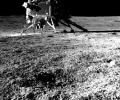
Chandrayaan-3 mission's Pragyan rover on Wednesday clicked an image of the Vikram lander, ISRO said.

'The Lunar Reconnaissance Orbiter imaged the area of the targeted Chandrayaan-2 Vikram landing site on October 14 but did not observe any evidence of the lander'

The rover will carry out in-situ chemical analysis of the lunar surface during the course of its mobility.
An ISRO official said: "Unless and until everything is intact (lander), it's very difficult (to re-establish contact). Chances are less. Only if it had soft-landing, and if all systems functioned, then only communication can be restored. Things are bleak as of now."

NASA posted images clicked by its Lunar Reconnaissance Orbiter camera, showing the site's changes on the Moon and the impact point before and after the spacecraft had made a hard-landing on the lunar surface.

Vikram and Pragyan payloads are now in a power-off mode until the south pole of the lunar surface is back in the range of the Sun again.

The Vikram Moon Lander, named after the father of India's space mission Vikram Sarabhai on his birth centenary year, is scheduled to touch the lunar surface near its south pole on September 7 about 1.55 am.

According to the space agency, Chandra's Surface Thermophysical Experiment measured the temperature profile of the lunar topsoil around the south pole, to understand the thermal behaviour of the Moon's surface.

The Vikram lander was 100 kilometers away from LRO, near Manzinus crater in the Moon's south pole region, when LRO transmitted laser pulses toward it on December 12 last year.

So, if ISRO is able to revive them as the Sun rises on the Moon again, information that is derived from experiments that could once again be conducted by the Chandrayaan-3 payloads would be a "bonus".
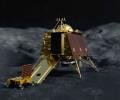
ISRO on Friday said it has made efforts to establish communication with its lunar mission Chandrayaan-3's lander Vikram and rover Pragyan to ascertain their 'wake-up condition' after they had been put into sleep mode early this month -- but no signals have been received from them as of now.

Subramanian, 33, who was on Tuesday the toast of the astronomy world, managed what ISRO and NASA couldn't through his close examination of before and after images of the scheduled landing.

Glimpses of what the historic Chandrayaan Mission discovered on the dark side of the Moon.

This image features the left image within the red channel, and the right image within the blue and green channels, resulting in a striking cyan hue.

The Chandrayaan-2 mission has made the first-ever observation of the effects of the Sun's Coronal Mass Ejection (CME) on the Moon using its onboard scientific instruments. This observation would help understand the lunar exosphere and the impact of space weather on its surface.

The precise location of the spacecraft in the lunar highlands has yet to be determined.
A complaint was lodged against the accused Mitul Trivedi, after he was seen giving interviews to the local media since the Vikram lander successfully made soft landing on August 24, claiming to have designed the lander module of Chandrayaan-3, the official said.

The space agency had got support from the entire nation, despite it losing communication with the lander ahead of the touchdown, with people from all walks of life praising ISRO and its scientists for the achievement.

Chandrayaan-3 mission's lander 'Vikram' chose a relatively flat region on the lunar surface to touch down, images captured by its camera showed.
The ISRO said that 90 to 95 per cent of the mission objectives have been accomplished, notwithstanding the loss of communication with the lander.

ISRO made efforts to re-establish communication with rover Pragyan and lander Vikram after they were put into sleep mode in September following the onset of night on the moon.

'Vikram' with rover 'Pragyaan' housed inside is scheduled for a powered-descent between 1 am and 2 am on September 7, followed by its touchdown between 1.30 am and 2.30 am.
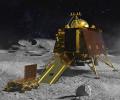
Most components of technology demonstration, including the launch, orbital critical maneuvers, lander separation, de-boost and rough braking phase were successfully accomplished.

ISRO on Friday released a set of visuals of the Moon captured by cameras positioned on the Lander Module of Chandrayaan-3 spacecraft.
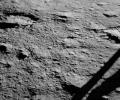
Speaking to PTI, Somanath said, "(The lander landed) perfectly in the intended site. The landing location was marked as 4.5 km x 2.5 km -- I think on that space, and the exact centre of that was identified as the location of landing. It landed within 300 metres of that point. That means it is well within the area identified for landing."
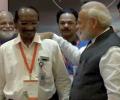
Minutes before making the announcement about losing communication with the 'Vikram' lander, ISRO Chairman K Sivan briefed the prime minister.

In his latest tweet, the 58-year-old actor said the successful landing of Chandrayaan-3 on the Moon's uncharted south pole was a moment of celebration for mankind.
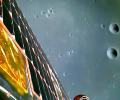
Taking to X (formerly Twitter), ISRO said, "Chandrayaan-3 Mission. Chandrayaan-3 Rover to MOX, ISTRAC, Moon walk begins!"
Conducting in-situ scientific experiments is underway. All payloads are performing normally, ISRO said.
The lessons learned from the failure of Chandrayaan-2 contributed to the success of India's third lunar mission, former space scientist with the Indian Space Research Organisation (ISRO) Nambi Narayanan said, after the successful touchdown of the 'Vikram' lander on the lunar South Pole.
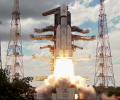
New data from India's Chandrayaan-3 mission suggests that ice might be present at more locations on the Moon's surface than previously believed. The study, published in Communications Earth and Environment, analyzed temperature data collected by the ChaSTE probe onboard the Vikram lander. The researchers found that significant variations in surface temperatures can influence the formation of ice, with slopes angled away from the Sun potentially providing favorable conditions for ice accumulation. The findings have implications for future lunar exploration, suggesting that water-ice resources could be more accessible than previously thought.

After the successful deployment of Chandrayaan-3's lander and rover on the moon, Indian Space Research Organisation (ISRO) is hoping that their mission life will not be limited to one lunar day or 14 earth days, and that they will come back to life when the sun again rises on the Moon, to carry on with the experiments and studies there.

Chandrayaan-3 mission's rover 'Pragyan' has traversed a distance of about eight metres on the lunar surface, and its payloads have been turned on, ISRO said on Friday.

Lander Module of Chandrayaan-3 spacecraft comprising the lander and rover has successfully separated from the Propulsion Module, Indian Space Research Organisation said on Thursday.

Its duties include experiments to further understand the lunar surface.
Asked if the lander was 'damaged' during the 'hard landing", Sivan said: "That we do not know".
